Husband Sándor Vay
Queer Places:
Móricz Zsigmond Theater, Nyíregyháza, Bessenyei tér 13, 4400 Hungary
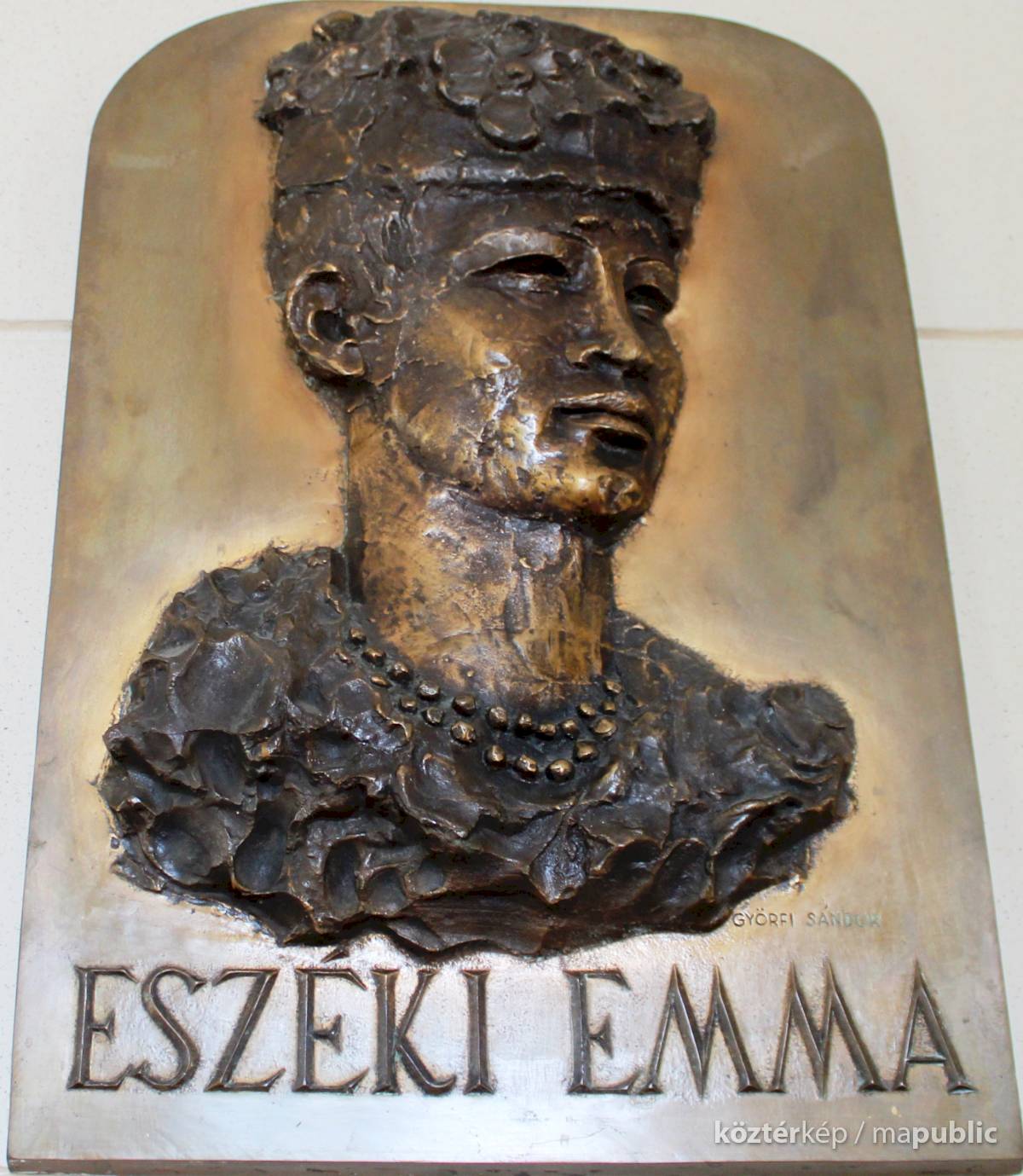 Emma Eszéki (April 11, 1854 - 1945) was a celebrated actress, among others a member of the amateur theatre company of Nyíregyháza. Eszéki pursued a career on the stage,
performing with various theatrical troupes and earning recognition and critical praise for her acting roles and guest appearances in regional theater centers like
Debrecen. In the foyer of the Móricz Zsigmond Theatre in Nyíregyháza, among several other memorial plaques, visitors can see a bronze relief of the former celebrated
actress, which is the work of the sculptor Sándor Györfi from Karcag. The bronze relief is approximately 30 by 40 centimeters in size, and the artist depicted the actress
with a braided bun hairstyle, a flowered hat, and a period dress. The theatre became an independent company in 1981, and the memorial plaque was inaugurated on this
occasion, along with the reliefs of other celebrities, as part of a series where a portrait of the namesake Zsigmond Móricz was created by József Rátonyi, of the theater
founder Gyula Somogyi by Sándor Sebestyén, of the architectural designer Ignác Alpár by Sándor Tóth, and of the actress Emma Eszéki by sculptor Sándor Györfi.
Emma Eszéki (April 11, 1854 - 1945) was a celebrated actress, among others a member of the amateur theatre company of Nyíregyháza. Eszéki pursued a career on the stage,
performing with various theatrical troupes and earning recognition and critical praise for her acting roles and guest appearances in regional theater centers like
Debrecen. In the foyer of the Móricz Zsigmond Theatre in Nyíregyháza, among several other memorial plaques, visitors can see a bronze relief of the former celebrated
actress, which is the work of the sculptor Sándor Györfi from Karcag. The bronze relief is approximately 30 by 40 centimeters in size, and the artist depicted the actress
with a braided bun hairstyle, a flowered hat, and a period dress. The theatre became an independent company in 1981, and the memorial plaque was inaugurated on this
occasion, along with the reliefs of other celebrities, as part of a series where a portrait of the namesake Zsigmond Móricz was created by József Rátonyi, of the theater
founder Gyula Somogyi by Sándor Sebestyén, of the architectural designer Ignác Alpár by Sándor Tóth, and of the actress Emma Eszéki by sculptor Sándor Györfi.
Emma Eszéki’s primary historical significance and connection to LGBTQ history stem from her romantic relationship and marriage with
Sándor Vay, born Countess Sarolta Vay, a prominent Hungarian poet, writer, and journalist who lived his entire life as a man. Vay
and Eszéki met around 1883 in Nyíregyháza while Vay was working as a correspondent. Vay pursued Eszéki, and the couple eventually eloped to Austria, where they were
married in a religious ceremony by a priest. Following their marriage, they returned to Pest and lived together in a small apartment on Lipót utca. To accommodate Vay's
lifestyle, Eszéki permanently abandoned her promising acting career.
Their relationship lasted from 1883 until 1887, when Vay ended the marriage after meeting Mari Engelhardt. To formalize the
separation, Vay paid a substantial financial settlement to Eszéki. When Vay's life later became the center of a sensational 1889 trial that publicly exposed his biological
sex and birth name after a subsequent marriage to another woman, Eszéki's past union with Vay was heavily scrutinized. Despite the legal deceptions and public scandals
surrounding Vay's passing as a man, Eszéki maintained that she had genuinely believed Vay was a biological man during their time together and continued to view herself as
having been his true wife for the remainder of her long life, lasting through her death in Budapest in 1945.
References:
- Richard von Krafft-Ebing, Psychopathia Sexualis (1906 edition, incorporating Case 166 on Sándor/Sarolta Vay, which details the background of his marriage to Emma Eszéki)
- Geertje Mak, "Sandor/Sarolta Vay: From Passing Woman to Sexual Invert," Journal of Women's History 16, no. 1 (2004): 54–77
- Anna Borgos, "Sándor/Sarolta Vay – A Gender Bender in Fin-de-siècle Hungary," in Comparative Hungarian Cultural Studies, edited by Steven Tötösy de Zepetnek and Louise O. Vasvári (Purdue University Press, 2011)
- Contemporary Hungarian press reports and biographical archives documenting Emma Eszéki's life (1854–1945), her theatrical career, her relationship with Sándor Vay from 1883 to 1887, and subsequent historical overviews published in literary journals and cultural blogs covering the period
Support this project
This website is a passion project researched, developed, and funded entirely by me. If you find the content valuable and would like to help support the ongoing research and hosting costs, any contribution is deeply appreciated.
Thank you for keeping this independent resource alive!
My books on Amazon: Elisa Rolle's books
BACK TO HOME PAGE